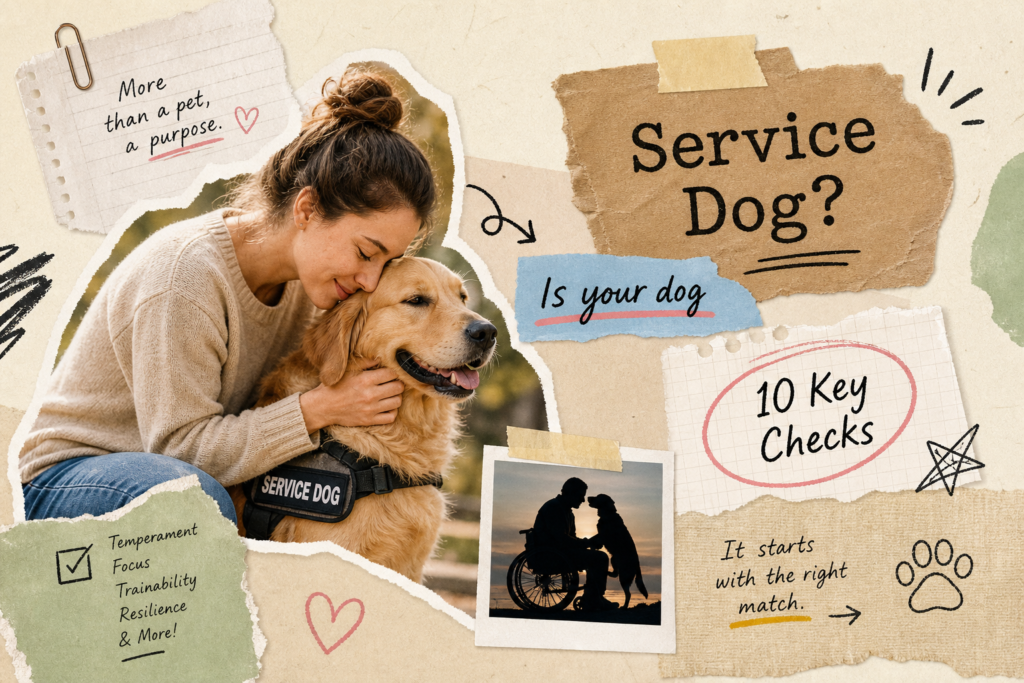
If you’re asking “is my dog cut out for service work,” you’re already thinking like a responsible owner-trainer. Start here: roughly half of all dogs in formal service programs wash out before completing training. That number climbs even higher in some programs, with estimates reaching 70% depending on selection criteria. Behavioral and health-related issues are the leading reasons, and in many cases, these issues are identifiable before intensive training begins. This isn’t discouraging news. It’s an invitation to look clearly at your dog before you invest months of structured work, financial resources, and emotional energy into a path that may not be right for them.
Service dog suitability is determined by individual temperament, health, and trainability, not breed alone. The ADA does not disqualify dogs by breed, and many dogs of all types fail selection not because of how they look but because of what they can sustain. Suitability comes down to a specific, assessable combination of traits: emotional stability, trainability, physical soundness, and the ability to stay focused under pressure. Most dogs simply don’t have all of these in the right measure. That’s not a criticism of those dogs. It’s just an honest reality of what service work demands.
At Collab Dog Training, we often observe owner-trainers skipping this readiness evaluation and moving ahead too fast. They fall in love with the idea of training their dog; but an objective assessment upfront protects both the dog and the handler from months of misdirected effort. Work through these 10 checks carefully to begin the process of seeing whether you’re dog could be a service dog (doesn’t replace an in-person assessment with a trainer; however, this is for your own educational purposes only).
What service work actually demands from your dog
The daily reality of public-access life
Picture a typical Wednesday: your service dog accompanies you through a crowded grocery store, waits beside your chair during a two-hour medical appointment, rides public transit next to strangers eating loud snacks, and navigates a parking garage with echoing concrete and sudden vehicle sounds. This is a long-duration job that requires sustained self-regulation across hours of unpredictable stimulation. A dog who is “pretty good in public” on a quiet Sunday morning is not the same as a dog who can hold steady through the full scope of real-world environments.
Under ADA guidelines, a service dog must remain under control and not pose a direct threat to others. The practical standard goes much further. A working service dog stays calm, quiet, focused, and unobtrusive across all of those situations without constant handler intervention. That gap between the legal minimum and the functional reality is where most evaluations need to be honest.
Why the bar is higher than most owners expect
A friendly, well-mannered dog is a great starting point, not a finish line. Many dogs who perform beautifully in the backyard or at a basic manners class fall apart in a busy hospital corridor or in a crowded airport. Service dog suitability requires a dog that can manage their own stress, hold handler focus in the presence of powerful distractions, and recover quickly when something unexpected happens, all without the handler constantly redirecting or reassuring them.
The 10 checks below give you a structured framework for assessing that honestly. Some gaps are workable, while others are genuine disqualifiers. Knowing the difference early is the most collaborative, dog-centered decision you can make.
Is my dog cut out for service work? Temperament and emotional stability
1. Stress tolerance and recovery speed
When something unexpected happens, does your dog notice, then reorient calmly within a few seconds? Or do they stay elevated, scan the environment, freeze, or shut down? That recovery window is one of the most telling indicators of service dog potential. Dogs with low stress thresholds cross into reactivity quickly, and even skilled training has limits when a dog’s baseline arousal is consistently high. A quick recovery after a mild startle is one of the strongest green flags you can observe.
2. Confidence in novel environments
A solid service dog candidate investigates new places with curiosity. They may pause and observe, but they move forward. A dog that freezes at the entrance to an unfamiliar building, tucks their tail in a new space, or over-alerts to ordinary environmental details is showing you something important. Situational nervousness in a young or under-socialized dog can sometimes be worked through with careful exposure. Pervasive fearfulness, where the dog is consistently shut down or avoidant across many different environments, is one of the leading reasons dogs fail service training entirely.
3. Reactivity toward people, animals, and sounds
Low reactivity is non-negotiable. A dog that lunges, barks, growls, or fixates on other dogs or strangers cannot safely perform public-access work, regardless of how well they perform tasks at home. The critical piece here is observing your dog in real-world settings rather than controlled home environments, where most dogs perform far better than they will on a busy street. Take your dog somewhere genuinely distracting and watch what happens before you decide what you’re working with.
For a deeper look at temperament indicators and how they predict public-access suitability, see this overview of service dog temperament indicators.
Is my dog cut out for service work? Trainability, focus, and drive
4. Handler focus and leash attention
Walk your dog in a mildly distracting environment and pay attention to one thing: does your dog check back in with you naturally, or are you always competing with the environment for their attention? Handler focus is the foundation every task and public-access behavior is built on. A dog that consistently treats the handler as background furniture will require substantially more ongoing effort to keep on task, effort that accumulates throughout years of working partnership.
5. Reward motivation and desire to train
Some people will describe this as wanting a “biddable service dog” but I like to use the word “trainability,” which means the dog genuinely wants to engage, work, and collaborate with you. In practical terms, this shows up as a dog that lights up when you produce food or a toy, that moves eagerly into training sessions, and that seems to find the interaction itself rewarding. Dogs with inconsistent motivation or very low drive are much harder to train to the reliability level service work demands. If food, play, and praise all leave your dog mostly indifferent, that’s a significant training challenge worth addressing honestly.
6. Problem-solving and persistence without panic
Place a treat under a container your dog can’t immediately access and watch what happens. Does the dog try different approaches, stay engaged, and work through the mild frustration? Or do they give up quickly, look to you for rescue, or escalate into anxious behavior? A dog that shuts down under mild cognitive challenge will struggle as training complexity increases. Equally, a dog that spirals into stress when confused is showing you a stress tolerance problem that will surface repeatedly throughout service work.
Practical field tests you can run this week
7. The stranger approach response
Have a neutral person approach your dog in a controlled, low-pressure setting. A passing response looks like relaxed body language, possible mild interest, and no strong behavioral reaction in either direction. The red flags sit at both ends of the spectrum: jumping, cowering, growling, or extreme excitement that can’t be redirected all create real public-access problems. Both over-friendly and under-friendly and anxious responses are worth taking seriously, not just the ones that look obviously concerning.
8. Noise and startle tolerance
Drop a set of keys nearby, open an umbrella, or briefly play a recording of crowd noise at low volume. The key variable isn’t whether your dog notices, it’s how fast they return to baseline. A quick reorientation toward you after a mild startle is a good sign. A prolonged stress response, continued scanning, trembling, or complete shutdown after a minor event suggests the noise sensitivity runs deeper than manageable. You can also test recovery directly: after a startle, offer a treat scatter and see if your dog can engage and settle.
If sound sensitivity is a specific concern, practical resources on sound-sensitive dogs and noise desensitization approaches may help you plan safe, gradual exposure work.
9. Surface and environmental novelty
Walk your dog across a slick floor, a metal grate, a ramp, or through sliding doors into a new building. Service dogs work across every environment their handler uses, and physical hesitation on unfamiliar surfaces can halt task performance at exactly the wrong moment. A dog that actively avoids certain textures or transitions needs specific desensitization work before you can accurately assess their readiness for broader public-access demands.
To compare your field observations against established standards, consider reviewing public-access assessments like my sample public access test here.
Health, age, and physical readiness
10. Structural health and stamina for the job
A dog’s physical condition is the foundation everything else rests on. Orthopedic problems like hip or elbow dysplasia, cardiac or respiratory conditions, chronic pain, and neurological disorders are common disqualifiers from service work, and many of them aren’t immediately visible to the untrained eye. Dogs under six months generally lack the developmental stability for reliable assessment, and most programs recommend beginning formal evaluation no earlier than that age. Older dogs with declining stamina, sensory loss, or age-related cognitive changes may not sustain the demands of full-time working life. Formal veterinary clearance belongs in your readiness process, not as an afterthought after you’ve already committed to a training path.
If you’re evaluating a young dog, the Puppy Temperament Test for Service Dogs: A Comprehensive Guide can help you understand which early signs predict later public-access suitability and how to structure early socialization and exposure work.
When health and behavior intersect
Pain and physical discomfort often show up as behavioral problems: reactivity, reluctance to work, low motivation, and increased stress signals can all trace back to an underlying physical issue. A dog that seems borderline on behavioral checks deserves a thorough vet evaluation before you conclude the problem is purely about temperament. This intersection is exactly why health assessment belongs inside the service dog readiness process, not separate from it.
Reading your results and planning next steps
If your dog checks most of these boxes, the path forward is structured foundational training with regular, honest check-ins at each stage. One of the most valuable things you can do before committing to a full training program is get an objective third-party perspective. When you’re emotionally invested in your own dog, it’s genuinely difficult to see clearly.
If your dog shows gaps or clear red flags, read this with full honesty and full compassion. Some gaps are workable with targeted training, low handler focus and mild environmental hesitation can improve meaningfully with the right approach. Others, including significant reactivity, pervasive fearfulness, and chronic health issues, are genuine disqualifiers. That doesn’t make your dog less valuable or less loved. It makes them a candidate for a different role: therapy dog work, at-home tasking, emotional support status, or simply being a deeply trained, or a deeply cherished pet.
Choosing the path that matches who your dog actually is, rather than forcing a path that creates stress for both of you, is the most collaborative decision you can make. And it starts with being willing to look clearly.
An honest evaluation is the most respectful place to start
Knowing whether your dog is truly suited for service work before you fully commit isn’t giving up. It’s training smart. The 10 checks in this article are a framework you can return to at any stage of the process, not just at the beginning. They reflect what experienced trainers look for, using structured assessments, long-term observation, and professional judgment, and they give you a common language for tracking progress honestly over time.
With many programs reporting washout rates between ~50 to 70%, that selectivity is real. It’s also the reason this assessment matters so much. Most dogs make wonderful companions and can learn impressive skills without ever being suited for full-time public-access work. The ones who do have what it takes deserve to be identified accurately and trained well.
CWhether you’re at the very beginning and still asking “is my dog cut out for service work,” or you’re mid-training and sensing something is off, our resources and coaching are built to guide you through with real information behind every decision. Explore my free training on my 3C method (my method I use to improve focus for ANY dog but the training is centered around service dog training).
Frequently asked questions
Is my dog cut out for service work if they’re a mixed breed?
Yes, the ADA does not restrict service dog status by breed, and suitability is determined by individual temperament, health, and trainability rather than lineage. Mixed-breed dogs succeed in service roles regularly. What matters is whether your specific dog has the stress tolerance, focus, and physical soundness the work demands. For general assistance-dog guidance and common questions about handlers’ rights and responsibilities, see this Assistance Dog FAQs.
Can my dog be a service dog if they failed one of these checks?
It depends on the check. Some areas, like mild surface hesitation or moderate handler focus, can improve with targeted training. Others, including significant reactivity, pervasive fearfulness, or a disqualifying health condition, are harder to work around. The key is being honest about which category your dog’s gaps fall into rather than assuming everything is trainable given enough time.
What are the most common service-dog washout criteria?
Across formal programs, the leading reasons dogs are removed from training, sometimes called service-dog “washed out” criteria, include fear and anxiety that doesn’t improve with training or requires medication to manage, reactivity to people or other animals that is due to the dog’s temperament (caveat is sometimes this is due to poor training mechanics from the handler…so if they are able to improve with coaching, there is a chance they could have what it takes; however, this area is nuanced), low handler focus, insufficient task motivation, and health conditions that affect soundness or stamina. Behavioral issues account for the majority of washouts, which is exactly why early assessment is worth prioritizing.
How do I know if my dog is cut out for service work versus therapy or emotional support work?
Service dog work is the most demanding role: it requires full public-access reliability, task performance under stress, and near-constant self-regulation, and a LOT of movement on different surfaces (i.e., need to be structurally and physically overall healthy). Therapy dog work involves supervised visits in controlled settings and suits dogs who are social and calm but may not have the stamina or focus for daily public access. Emotional support status has no public-access rights and no task requirement, it’s appropriate for dogs who provide comfort at home. If your dog passes several but not all of these checks, one of those alternative roles may be a genuinely excellent fit.