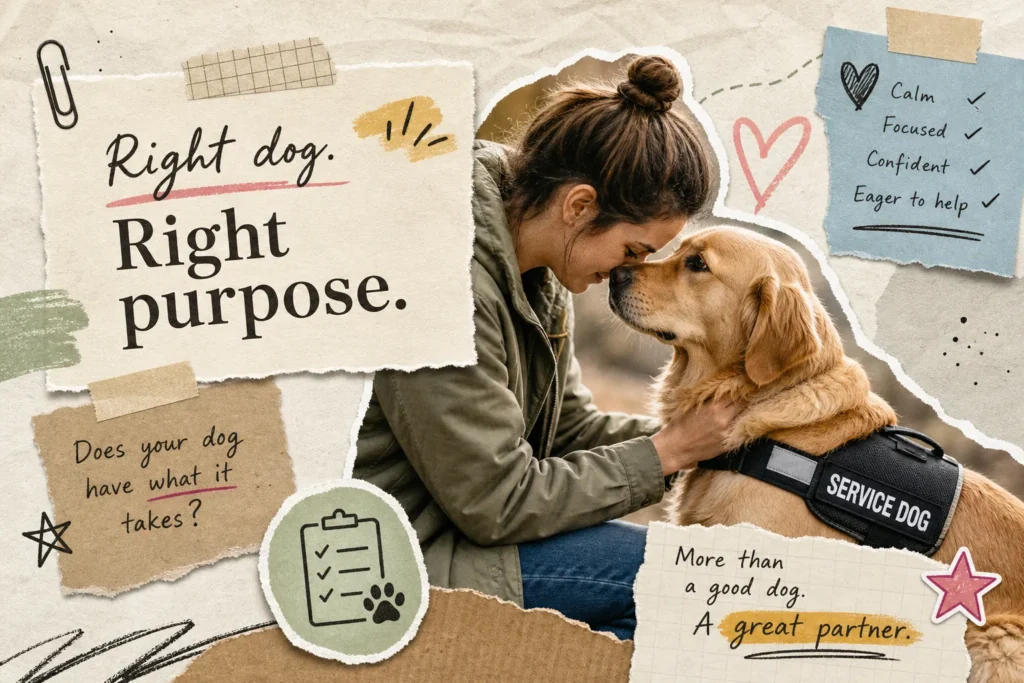
Is my dog the right temperament for service dog training? If you’re considering self-training a service dog, that question carries real weight, not just emotionally, but financially. Program-trained dogs often cost tens of thousands of dollars, and wait lists can stretch for years. So figuring out whether your current dog has what it takes isn’t an abstract exercise. It’s one of the most practical decisions you’ll make.
Here’s the hard truth most people don’t hear clearly enough: most dogs are not suited for service work. Not because they’re bad dogs, but because service work demands a very specific set of emotional and behavioral qualities that no amount of training can manufacture in a dog who doesn’t have them. Knowing this early, before you invest months of time and hundreds of dollars in training, is one of the most important things you can do for both yourself and your dog.
This guide walks you through the observable traits that predict service dog success, simple real-world tests you can run right now, and the behavioral red flags that should stop you in your tracks. At Collab Dog Training, we treat this kind of assessment not as a pass/fail judgment on your dog, but as a clear-eyed look at who your dog actually is. That honesty is the foundation of any real training relationship.
Is My Dog the Right Temperament for Service Dog Training? Key Traits to Look For
Professional service dog programs don’t evaluate dogs by how well they sit or how much they love their owners. They look at temperament, the underlying emotional and behavioral wiring that determines how a dog handles the world. Training can shape behavior, but it cannot change a dog’s fundamental temperament.
Confidence and emotional stability
A service dog prospect needs to move through unfamiliar environments with settled, curious engagement. This isn’t the same as boldness. A dog who is bold but impulsive, charging at everything with no self-regulation, is just as disqualifying as a dog who shuts down from fear. The target is a dog who notices something new, investigates calmly, and carries on. Stable confidence under real-world pressure is the trait everything else is built on. For additional perspective on temperament, confidence, and work drive in service dog candidates, see this resource on what makes a great service dog prospect: temperament, confidence, and work drive.
Resilience and startle recovery
Every service dog will be startled. A shopping cart drops. A bus door hisses. A child shouts out of nowhere. What matters is not whether a dog startles, but how quickly they recover. A strong candidate startles, reorients, and re-engages with their handler quickly. A dog who remains shut down, hypervigilant, or fearful after an unexpected event is telling you something important about how they’ll handle the daily demands of public access work.
Drive to work with people and natural focus
Food motivation, toy drive, and a natural tendency to make eye contact with their handler are not tricks. They are indicators of willingness to engage in a working partnership. A dog who naturally seeks out human connection and checks in with you during walks or new situations is showing you the raw material of a working relationship. A dog that is aloof, self-sufficient, or disengaged from people is going to be significantly harder to build this kind of partnership with.
Low prey drive and low baseline reactivity
These are not traits you can reliably train away. A dog with a strong prey drive who lunges after squirrels or small dogs in public is a safety issue, not a training problem to solve later. The same applies to baseline reactivity toward triggers in the environment. Temperament is more predictive of service dog success than breed, but these behavioral baselines must be present regardless of what breed you’re working with.
At-Home Service Dog Temperament Tests You Can Run Right Now
You don’t need a formal evaluation facility to begin your service dog prospect evaluation. These three scenarios give you real, observable data to work with.
The novel environment test
Take your dog somewhere genuinely new: a hardware store parking lot, a busy sidewalk in an unfamiliar neighborhood, or a park with equipment they’ve never seen. Watch what they do. Does the dog explore with forward, curious energy? Or do they freeze, pull toward the exit, or refuse to engage? A dog who experiences a moment of hesitation and then recovers to investigate is showing resilience. A dog who stays flat, trembling, or fixated on escaping is showing you their limits.
The startle and distraction test
Drop a set of keys behind your dog without warning. Have a friend open an umbrella nearby. Observe both the initial startle response and, critically, the recovery time. How many seconds does it take before your dog disengages from the surprise and returns their attention to you? Then add a distraction check: ask for a known behavior like “sit” or “watch me” near a moderate-level distraction. A dog who can hold focus on you near a real-world distraction, even briefly, is demonstrating something meaningful. A dog who can’t disengage from the environment at all is showing you what public access would look like.
The social exposure check
Observe your dog around strangers of different ages, appearances, and energy levels. A service dog prospect should remain relaxed and neutral, not necessarily friendly, but not avoidant or over-excited either. Enthusiastic jumping and greeting is not what you’re looking for. Neither is pulling away, freezing, or barking. The target behavior is calm, settled neutrality: the dog notices the person, remains relaxed, and continues with whatever they were doing.
Behavioral red flags that typically disqualify a dog
Some issues fall clearly outside the range of what training can address for service work. Being honest about these is an act of care for your dog, not a failure.
The non-negotiable disqualifiers
Any history of biting or out-of-context aggression, growling, lunging, resource guarding, is effectively disqualifying for public access work in almost all cases. Severe fear responses, including freezing, fleeing, or urinating from fear, fall into the same category. These behaviors are extremely difficult to remediate to public-access standards, and in most cases there is no reliable workaround. Placing a dog with these histories into a service role doesn’t just set the dog up to fail, it typically makes the underlying behavior worse and creates new problems that didn’t exist before.
Gray-zone issues that still raise serious concerns
Separation anxiety, persistent sound phobias, and strong prey drive toward wildlife or small animals fall into a category where the dog may be a wonderful pet, but is not appropriate for service work. These aren’t criticisms of the dog. A dog with separation anxiety who falls apart when left alone for ten minutes, cannot be a reliable service partner in environments where their handler may need to step away briefly. The standard for a service dog is simply different from the standard for a well-loved family pet, and that’s not a judgment on either.
A reality check on the numbers
Industry data from major service dog programs suggest that roughly half of purpose-bred, professionally selected dogs wash out of service training. For owner-selected, owner-trained dogs, the success rate is estimated to be far lower, some figures cited in the field point to single-digit percentages. This is not meant to discourage you. It’s context. These numbers explain why the service dog temperament test matters so much before a single training dollar is spent. Knowing early that your dog isn’t suited for service work is not a loss. It’s information that protects your time, your resources, and your dog. For more on research aimed at improving working dogs and industry outcomes, see this overview of research to improve working dogs.
How age and background shape what you can reliably assess
The reliability of a temperament assessment depends heavily on when you conduct it and what you know about your dog’s early life.
Timing your evaluation: puppies vs. adult dogs
An initial observation at 7 weeks can offer early signals, but a definitive assessment isn’t reliable until the dog reaches 18 to 24 months, when temperament is fully stable. The fear period around 5 to 6 months can temporarily cloud the picture, making a confident puppy appear more anxious than they actually are. A puppy who looks exceptional at 8 weeks may still wash out at 18 months. Early promise is worth tracking, not banking on. If you’d like a step-by-step method for evaluating young puppies, see our Puppy Temperament Test for Service Dogs for a comprehensive guide on what to watch for.
Why early socialization history matters more than most owners realize
Dogs raised in a home environment with diverse early socialization (car rides, varied flooring, different people, household sounds) arrive at training with a significant advantage over kennel-raised dogs. Puppies from breeders who have produced dogs with working titles, obedience accomplishments, or service placements are stronger candidates. A kennel-raised puppy with minimal human contact in their first 12 weeks is rarely a competitive service prospect, regardless of breed. For practical guidance on early puppy development and purposeful socialization at 7, 12 weeks, see this piece on development and socialization of 7 to 12-week-old puppies.
Assessing rescue dogs fairly
Rescue dogs deserve a fair evaluation, and that means waiting 2 to 3 weeks after adoption before drawing any conclusions. Decompression behaviors, hiding, shutdown, over-reactivity, can mask a dog’s true temperament. Once the dog has settled, apply the same service dog candidate traits you would to any prospect: resilience, confidence, social ease, and focus. Some rescue dogs are genuinely excellent candidates. Many are not, and that’s not a reflection of their value as a companion. For guidance on selecting a suitable puppy or dog prospect, resources like how to pick a puppy service dog prospect can help clarify important early-life considerations.
When a professional evaluation is the right next step
Self-assessment has real limits. The emotional connection you have with your dog makes it genuinely difficult to see clearly what a trained eye picks up immediately. That’s not a personal failing. It’s human. A professional temperament assessment includes structured evaluation scenarios, a review of your dog’s behavioral history, and an honest read of what the dog is actually showing rather than what you’re hoping to see. It also protects you from investing months of training time and significant money into a dog who was never going to make it through the process.
At Collab Dog Training, one-on-one coaching and temperament consultations are available via Zoom anywhere in the U.S. or in-person in Arvada, Colorado, specifically designed to help you answer the question of whether your dog is the right temperament for service dog training before you commit to a full program. Lisa Gallegos (CPDT-KA) can walk through your dog’s behavioral history, review what you’ve observed in the at-home tests, and give you a clear picture of whether your dog is a genuine prospect, needs more time to mature, or is better suited to be an exceptional pet. If your dog does have the right foundation, the Public Access Prep course and personalized coaching provide a structured, force-free path forward built on genuine collaboration. You can also learn more by joining our free webinar, How to Self-Train a Reliable Service Dog.
FAQ: Is My Dog the Right Temperament for Service Dog Training?
At what age should I assess my dog’s service dog temperament?
A meaningful assessment is possible as early as 7 weeks, but temperament doesn’t fully stabilize until 18 to 24 months. Avoid drawing firm conclusions during the 5-to-6-month fear period, and treat any early promise as a signal worth watching rather than a guarantee.
Can training fix a dog who fails the temperament tests?
In most cases, no. Training can shape behavior and build skills, but it cannot change a dog’s underlying temperament. If your dog shows severe fear responses, consistent aggression, or an inability to recover from startle, those are foundational issues that training alone is unlikely to resolve to public-access standards.
Are certain breeds automatically better service dog candidates?
Breed can influence general tendencies, Labrador Retrievers, Golden Retrievers, and Standard Poodles are common in service work, but individual temperament is a stronger predictor of success than breed alone. A well-tempered mixed-breed dog can outperform a poorly tempered purebred every time.
How do I know when to stop self-assessing and get professional help?
If you’ve run the at-home tests and still aren’t sure what you’re seeing, or if your dog is showing any gray-zone behaviors like mild reactivity, anxiety, or inconsistent focus, a professional evaluation is the right next step. The cost of a consultation is a fraction of what you’d spend on months of training that leads nowhere.
What this evaluation is really about
Most dogs are not suited for service work, and knowing that early is an act of love for both you and your dog. It spares you months of frustration. It spares your dog from being placed in a role that doesn’t fit who they are. And it gives you accurate information to make the best decision for both of you.
If you’re still asking yourself whether your dog is the right temperament for service dog training, that uncertainty itself is worth exploring with a professional. Observe the core traits, run the real-world tests, and watch for the red flags. If your dog clears those hurdles, a professional evaluation can confirm what you’ve observed and map out a plan that makes sense for your specific situation.
Whether your dog becomes your service partner or your beloved companion, understanding their true temperament is the starting point of any honest training relationship. That clarity is worth more than any shortcut.