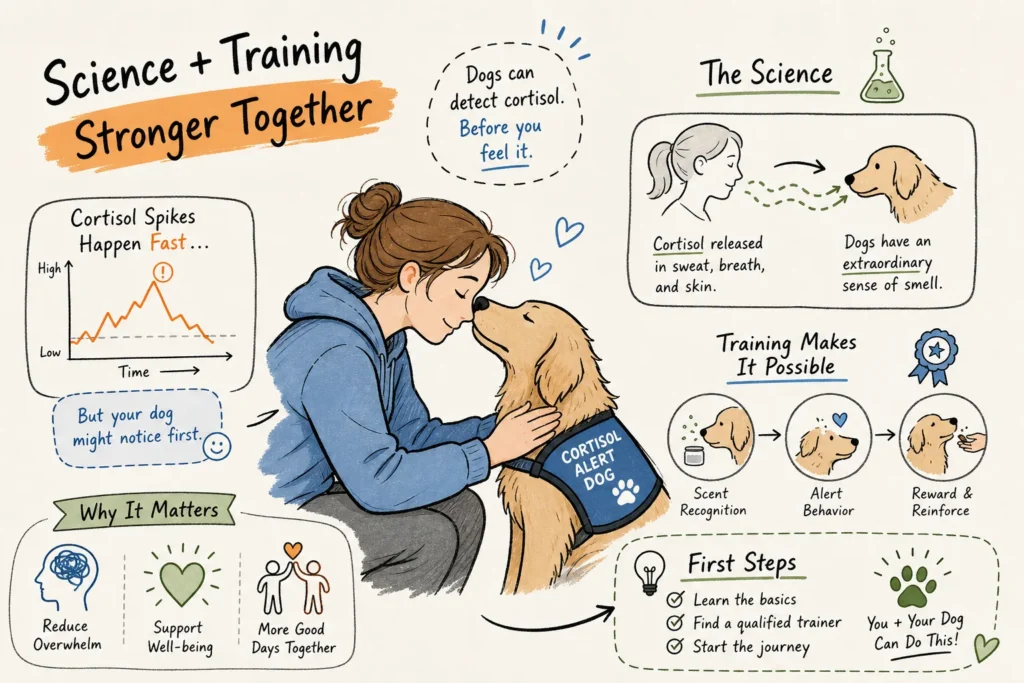
A dog nudging its handler’s leg before an adrenal crisis sounds like something out of a movie. But the scent science behind it is real, and for people living with adrenal insufficiency or conditions like Addison’s disease, a cortisol alert dog isn’t a fantasy. Anecdotal and single-case evidence suggests a trained dog may provide early alerts that help a handler act before a crisis develops, though large-scale validation is still lacking, and outcomes vary by individual.
What makes this area so frustrating is the gap between what’s biologically possible and what’s actually available. Cortisol alert service dogs are rare, poorly understood outside specialist circles, and deeply underserved by the mainstream training industry. Many trainers report limited or no direct experience with cortisol-specific alerts, and the research, while promising, remains in its early stages, documented primarily through a single published case study.
This article covers everything you need to make an informed decision: who benefits from this type of dog, what the science actually shows, how training works step by step, the legal framework that protects you, and where to get real guidance if you want to pursue owner-training. At Collab Dog Training, Lisa Gallegos (CPDT-KA) works specifically on medical alert and psychiatric service dog tasks, including the scent conditioning foundations behind cortisol detection, and we’ll point you toward those resources at the end.
Who actually benefits from a cortisol alert dog
Conditions that create unpredictable cortisol drops
The primary medical use case is adrenal insufficiency, particularly Addison’s disease, a condition where the adrenal glands don’t produce enough cortisol. Without adequate cortisol, the body can’t regulate stress responses, blood pressure, or blood sugar, and a drop can escalate into an adrenal crisis that requires emergency intervention. The challenge is that the warning window between feeling slightly off and collapsing can be extremely short. A service dog for low cortisol trained to detect these shifts may give a handler time to act before that window closes.
Possible secondary applications include PTSD, severe anxiety disorders, and other conditions where stress-triggered cortisol spikes or crashes disrupt daily functioning. This remains speculative, and specific studies demonstrating reliable cortisol-detection utility for these conditions are limited. For handlers with adrenal insufficiency, an adrenal crisis alert dog creates a potential window to take medication, sit down, or contact support according to their medical protocol. Catching a drop early can be clinically significant, anecdotal reports suggest a trained dog may provide a subtle early signal, though this has not been quantified in controlled research.
What alerting looks like in daily life
Reported cases describe cortisol alert dogs detecting a scent change before the handler feels any symptoms. A cortisol-detecting dog doesn’t wait for you to feel dizzy or confused. It responds to the chemical shift in your sweat or breath that appears to precede those symptoms, though no controlled studies have quantified the typical lead time between alert and symptom onset. That potential early warning is what makes these dogs valuable.
In practice, this looks nothing like a movie scene. It’s a persistent nose bump during a work meeting, a dog sitting and making eye contact at the kitchen table, or a dog that won’t leave your side even though you feel completely fine. These are quiet, trained signals, not dramatic behaviors. It’s also worth being clear: this is not the role of an emotional support animal. A cortisol alert dog performs a specific, trained detection task that qualifies under service animal law, which carries entirely different legal protections.
Why these dogs are so hard to find
No major U.S. organization runs a standardized program specifically for cortisol or adrenal insufficiency detection dogs. The training is described in the literature as “one-off” and difficult to obtain reliably. While organizations like Medical Detection Dogs in the UK have documented cases, that infrastructure simply doesn’t exist at scale in the United States.
Program-trained medical alert dogs are industry-wide estimates at $15,000 to $30,000, and wait lists can stretch years, though cortisol-specific placements lack standardized waitlist data given the absence of established U.S. programs. Cortisol-specific dogs are even rarer within that already-limited pool. Owner-training with qualified expert guidance is currently the most realistic and accessible path for most people, given both cost and the lack of standardized U.S. programs for this specific alert task.
What the science actually says about dogs detecting cortisol
The single case study everyone cites
The evidence is limited, and it’s worth being direct about that. The published research on dogs detecting human cortisol levels comes down to one case study involving one patient and her dog, trained using Pavlovian conditioning. The reported outcome was meaningful: the patient’s steroid management improved significantly and her quality of life increased. But the study reported no accuracy metrics, and the authors themselves explicitly called for further investigation before drawing broad conclusions. Local news coverage has also highlighted isolated training efforts documented outside the research literature, reflecting the early-stage and anecdotal nature of this work. See one example reported in the media.
That limitation doesn’t mean the capability doesn’t exist. Dogs have demonstrated validated ability to detect cancer, low blood glucose, and bacterial infections through scent. The biological plausibility for cortisol detection is real, the body releases volatile organic compounds (VOCs) when cortisol levels shift. The research simply hasn’t caught up yet, and controlled studies are needed to establish accuracy, timing, and reliability across a broader population. Reviews of canine medical detection literature summarize many of these disease-detection capabilities and provide useful background on methodology and validation in the scientific record.
How dogs detect scent changes at the biological level
When cortisol levels change, the body releases VOCs through sweat and breath. These chemical signatures are detectable to a dog’s olfactory system, and reported cases suggest alerts can occur before the handler experiences physical symptoms. That’s what makes early detection plausible: the scent change may precede the crisis, not accompany it. Work on VOC identification and analysis helps explain why scent-based detection is biologically credible and identifies what compounds researchers target in lab studies; this is discussed in analytical chemistry literature on VOC profiling examining volatile markers.
One critical distinction is that dogs aren’t detecting a universal “cortisol smell.” They’re learning to detect a shift away from their specific handler’s baseline scent. This is why sample collection during a stress event is essential, and why control samples taken at a calm baseline are equally important. The dog learns the contrast between the two states, not an abstract chemical profile.
Why the research gap doesn’t disqualify the capability
Diabetic alert dogs followed this exact same trajectory: years of anecdotal reports and trainer experience before rigorous peer-reviewed studies confirmed what handlers already knew. The training mechanics used for cortisol detection are consistent with proven protocols for other scent-based medical alerts, which means trainers have a working framework to build from even without a large body of cortisol-specific literature. For readers interested in how similar detection disciplines developed and were scientifically evaluated, see examples of controlled canine scent-detection studies that helped establish credibility for medical scent work in peer-reviewed journals.
Honest framing matters here. Alerts should be treated as early warnings, not medical diagnoses. A well-trained AID dog, trained for adrenal insufficiency detection, gives you a head start, but your response protocol should still follow established medical guidance rather than relying solely on the dog’s indication.
How cortisol alert dog training actually works
Step 1: Collecting the right scent sample
Samples are collected through sweat, not saliva. Sweat is the preferred medium for scent training according to practitioners and the published case study guidance, as it appears to capture the stress-specific odor most reliably. Collection site matters: the back of the neck and underneath the bra line are identified in the literature as preferred areas. Clean gauze or a cotton pad is used with gloves to prevent cross-contamination, and the sample is frozen immediately after collection to preserve the scent.
Timing matters too. Practitioner guidance recommends collecting samples when the handler’s heart rate is above 100 bpm, capturing an actual physiological stress state rather than a subjective sense of anxiety. This threshold comes from practitioner guidance in the published research and is a practical recommendation rather than a universally validated physiological cutoff. Control samples taken during calm periods are just as important; without them, the dog has no reference point for the contrast it needs to detect.
Step 2: Scent pairing through classical conditioning
Training begins with multiple containers: some hold the cortisol sample and some hold baseline control samples. The dog sniffs each container and receives a food reward from the back of the tube holding the target cortisol scent. The reward is consistently paired with that specific odor so the dog builds a strong association.
Once that association is established, food is removed from the tube and becomes a consequence delivered separately by the trainer. This keeps cortisol as the distinct target rather than turning the food itself into the cue. Training then progresses from simple environments to more complex ones, with additional containers added over time so the dog stays focused on the target scent rather than any incidental variables.
Step 3: Teaching the alert behavior separately
This is one of the most important principles in the entire protocol: the alert behavior is trained as its own distinct cue before it’s ever connected to scent. Common alert behaviors include nose bumping the hand, persistent nudging, or sitting and making eye contact. These are passive, clear, and easy to recognize in real-world situations.
Only after both skills are independently reliable does training link the scent detection to the alert behavior. This separation prevents confusion, improves reliability, and significantly reduces false alerts. Rushing this stage is one of the most common reasons medical alert dogs underperform in real life. Taking the time to build each skill cleanly before combining them makes the difference between a dog that alerts accurately and one that alerts inconsistently.
Alert behaviors and how handlers should respond
Passive versus active alert tasks
Most cortisol alert dogs use passive alerts as their primary behavior: a nose bump, persistent nudging, or sitting and pawing at the handler’s leg. These are trained first because they’re reliable, low-stress for the dog, and easy for handlers to recognize clearly in public without drawing excessive attention.
Secondary tasks may include fetching emergency medication, alerting a nearby person, or continuing to alert if the handler becomes unresponsive. These are separate, additional skills layered in once the primary alert is solid. The passive alert is the foundation; everything else builds from there.
What handlers should do when a dog alerts
The response protocol is just as important as the training protocol. When a dog alerts, the handler should take immediate action: self-injecting steroids, taking oral medication, or contacting medical support depending on the established protocol for their condition. The alert is a signal to act now, not to wait and see if symptoms develop.
Handlers should stay calm and consistent in their response regardless of whether they feel symptoms yet. Avoiding reinforcement of false alerts requires a steady, predictable response pattern. Working with a trainer who understands both the detection task and the handler’s specific medical condition allows you to build a response plan that actually fits your situation rather than a generic template.
Legal classification and ADA protections
How the ADA classifies cortisol-detecting dogs
Under the ADA, a cortisol alert dog qualifies as a service animal when it is individually trained to perform a disability-related task for its handler. No federal documentation, certification, or medical records are required. Service providers may only ask two questions: does the owner have a disability, and does the dog assist with that disability.
This is a meaningful legal distinction from emotional support animals, which do not carry the same public access protections. A task-trained service dog has full access rights under federal law. For dogs still in training, the ADA does not grant automatic public access; state laws govern in-training dogs, and those vary significantly. States like Arizona, Florida, and Louisiana grant full public access rights to service dogs in training, while others do not. Knowing your state’s rules is part of the preparation process.
Recommended standards when vetting trainers
Federal law sets no training standards, but for a life-critical medical alert, the vetting standard should be high. Becky Causey, a trainer cited in the published research on adrenal insufficiency service dogs, recommends asking directly: “How many cortisol or adrenal insufficiency dogs have you trained, and how long have they worked reliably with their handlers?” The benchmark she identifies is at least one dog that has worked successfully for a continuous year.
For owner-trainers, this standard applies to the guidance you seek as much as to the trainer themselves. You need someone who can troubleshoot real-world problems, not just walk you through a generic scent conditioning video.
Getting started: owner-training and where to find expert guidance
Why owner-training is the most realistic path right now
No standardized U.S. organization offers a cortisol-specific program as a consistent service. Private custom training exists but is expensive, inconsistent, and often unavailable depending on where you live. Owner-training gives handlers direct control over the process, keeps costs significantly lower, and allows the dog to bond with the handler throughout every stage of training rather than being placed after the fact.
The scent detection mechanics used for cortisol work closely parallel scent training for diabetes alert dogs, which is more established. Any trainer experienced in medical scent detection can adapt this protocol with the right foundational knowledge and guidance. The mechanics transfer; the specifics of cortisol sample collection and control sample management require targeted instruction. For additional community resources and examples, see the diabetes alert dog tag on Collab Dog Training’s site.
What to look for in a trainer or course
Force-free methodology isn’t just an ethical preference here, it’s a functional requirement. Punishment-based training raises a dog’s cortisol levels, which directly interferes with scent imprinting and undermines the learning process. You need a trainer who understands that the dog’s own stress response must stay low throughout training.
Look for structured course modules that cover scent introduction, discrimination, control samples, and alert behavior training as distinct, sequential stages. One-on-one coaching access matters for this specialty because troubleshooting false alerts, refining sample collection, and building a reliable response protocol requires personalized feedback, not just pre-recorded content.
How Collab Dog Training supports this work
Lisa Gallegos (CPDT-KA) at Collab Dog Training specializes in psychiatric service dog task training and medical alert work, including the foundational scent conditioning protocols behind cortisol detection. Whether you’re evaluating whether your dog has the right temperament for scent work or ready to build a full alert training protocol, Collab provides structured, compassionate guidance in a niche where qualified support is genuinely hard to find.
Collab offers detailed course modules that walk owner-trainers through each stage of the process, along with one-on-one Zoom coaching sessions with custom training plans for each dog-handler team. Remote coaching is available to U.S. clients nationwide, which means geographic barriers don’t have to stand between you and qualified expert guidance in a field where that guidance is rare.
What to take away from all of this
The scent conditioning mechanics behind cortisol alert dog training are grounded in proven protocols, and the biological plausibility is solid, even if large-scale research hasn’t caught up yet. To be clear: empirical validation is currently limited to a single case study, and controlled studies are needed before broad claims about effectiveness can be made. The gap isn’t in what dogs are capable of; it’s in the availability of trainers who know how to teach this correctly. Owner-training with structured, force-free expert guidance is the most accessible path available to most people right now, given both the cost of program-trained dogs and the absence of standardized U.S. cortisol-specific programs.
This is specialized work. It requires a trainer who understands scent discrimination, medical alert protocols, sample collection, and how to build a reliable response plan tailored to a specific handler’s condition. Generic obedience training won’t get you there, and neither will a program built for a different alert task used without adaptation.
If you’re exploring whether a cortisol alert dog is right for your situation, start by reading through Collab Dog Training’s Cortisol Medical Alert Training for Dogs: How to Start the Right Way to build your foundational understanding. From there, a one-on-one Zoom coaching session with Lisa can help you assess your dog’s suitability, walk through what the training process looks like for your specific needs, and build a clear, realistic plan forward.