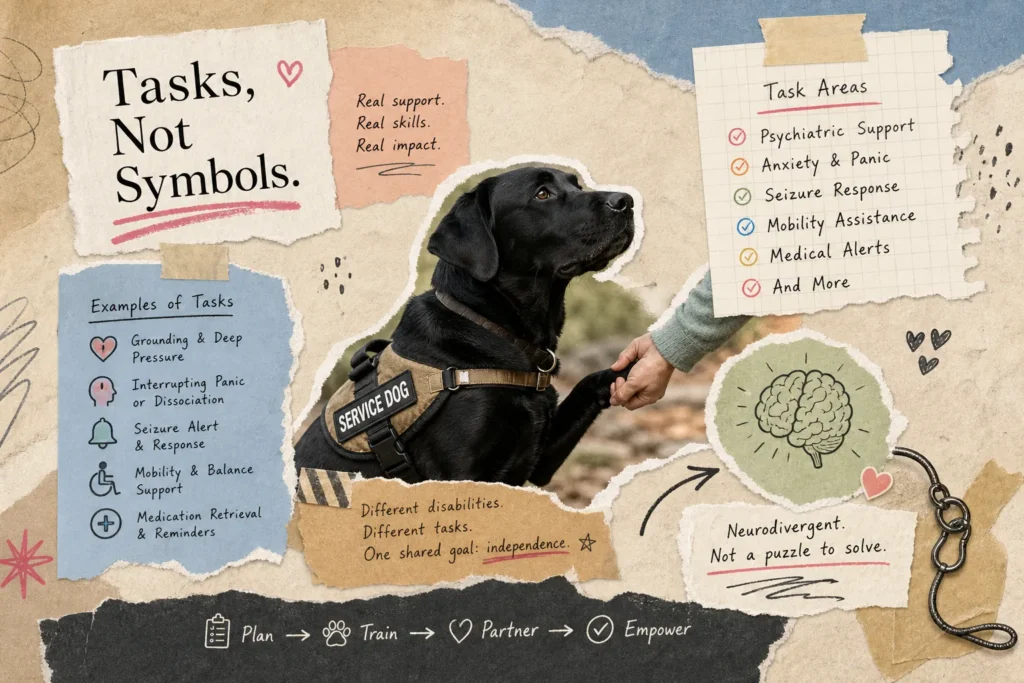
A frequent question service dog handlers face in public isn’t about paperwork or certifications, it’s simply: “What tasks does your dog perform?” This service dog tasks list exists to give you a clear, legally grounded answer to that question. Fumbling that answer, or worse, having trained behaviors that don’t actually meet the legal definition of a task, creates real problems. You can be denied access, questioned repeatedly, or end up months into training a dog who doesn’t have work that qualifies under federal law.
At Collab Dog Training, task identification frequently comes up in coaching sessions. Handlers often know their dog does something helpful but can’t articulate it precisely. Below you’ll find a disability-organized service dog tasks list that is legally grounded and training-realistic, built for real handlers who need clarity, not theory. The psychiatric service dog section goes deepest, because that category carries the most nuance and generates the most training gaps.
What makes a task legally qualify as service dog work
Before evaluating any task example, you need the right legal frame. The ADA defines a service animal as a dog individually trained to perform work or tasks directly related to a person’s disability. That definition contains two non-negotiable elements: the behavior must be trained (discrete, reliable, and repeatable), and it must be directly related to the disability. A dog that simply provides comfort or whose presence happens to reduce anxiety does not qualify as a service animal under federal law, no matter how genuinely helpful it feels.
The task must also mitigate a functional limitation caused by the disability, not just make life more convenient. Retrieving dropped keys for a handler with limited hand mobility qualifies because it addresses a physical limitation the disability creates. Teaching a dog to retrieve keys as a fun trick does not qualify, even if it’s the same physical behavior. Run every potential task through this filter before you start training: does this behavior address something my disability prevents me from doing safely or independently?
Service dog tasks list: mobility, guide, and hearing dog work
Physical assistance tasks for mobility disabilities are among the most recognized in the field. Common trained behaviors include forward momentum assist (helping a handler walk or push up an incline), counter-balance and bracing to prevent falls, pulling a manual wheelchair, and assisting with transfers between surfaces. The list of service dog tasks in this category also covers retrieving mobility aids like canes or walkers and pressing accessibility buttons for automatic doors or elevators. These tasks require significant body awareness and physical conditioning in the dog, which is why breed selection and size compatibility with the handler matter considerably in this category, particularly for bracing and pulling work.
Guide dog tasks center on safe navigation for handlers who are blind or have low vision. The trained work includes obstacle avoidance (including overhead hazards like low branches or signage), locating curbs and steps, and intelligent disobedience, the dog’s trained ability to refuse a command that would cause harm, such as stepping into oncoming traffic. Hearing dogs perform a different kind of alerting work: they learn to respond to specific sounds (smoke alarms, doorbells, name calls, phone alerts), make physical contact with the handler, and then lead them toward the sound source. These tasks are highly customizable to an individual handler’s home environment and daily routine. For a broad catalog of task examples across categories, see the giant list of service dog tasks.
Psychiatric service dog tasks: a detailed breakdown
This is where task training gets most nuanced and most often done incorrectly. Psychiatric service dog tasks must meet the same trained-behavior standard as any other category, which means the dog cannot simply be present or attentive. The behavior has to be discrete, reliable, and triggered either by a specific cue from the handler or by an observable behavioral signal from the handler.
Grounding and deep pressure therapy
Anxiety grounding tasks involve the dog making deliberate, trained physical contact to interrupt a dissociative or anxious state and re-anchor the handler to the present. This can look like the dog placing its paws on the handler’s lap, leaning weight into the handler’s legs, or repeatedly nudging with its nose. Deep Pressure Therapy (DPT) takes this further: the dog applies body weight across the handler’s lap or chest to reduce physiological anxiety responses, similar in effect to a weighted blanket. DPT must be trained with precise criteria. The dog must apply pressure on cue or in response to a behavioral trigger from the handler, not simply settle in for a cuddle.
Panic interruption and crowd management
Panic interruption tasks are designed to break a building panic loop early, before it escalates. The trained behavior typically involves the dog nudging, pawing, licking, or nosing the handler to interrupt the behavioral cycle. Crowd blocking tasks use the dog’s body as a physical buffer: the dog positions itself between the handler and approaching people, either standing directly behind the handler or circling them, to reduce sensory overwhelm from others entering personal space. Both of these tasks require a dog with a confident, non-reactive temperament above all else. A dog that is itself anxious in crowds cannot reliably perform crowd management tasks.
Nightmare interruption and behavioral redirection
Nightmare interruption tasks involve the dog alerting to the handler’s physical stress cues during sleep, elevated movement, vocalizations, hyperventilation, and waking them using trained contact such as pawing or jumping onto the bed. Behavioral redirection tasks interrupt repetitive or harmful behaviors, including skin picking, scratching, or other stress-driven actions, by physically redirecting the handler’s hands using a nose touch, paw, or nudge. These tasks require careful shaping and clear criteria so the dog responds to the actual behavioral signal rather than offering the behavior randomly. Many handlers use specifically designed PTSD service dog tasks in nightmare interruption training when sleep-related trauma symptoms are present.
This level of precision, defining triggers, micro-behaviors, and response criteria, is exactly what our psychiatric service dog training resources focus on, including stepwise shaping, proofing, and public access readiness.
Medical alert tasks: diabetic, seizure, and scent-based work
Diabetic alert dogs detect blood sugar changes through scent before the handler notices symptoms of hyperglycemia or hypoglycemia. The trained task includes a reliable, consistent alert behavior (pawing, nudging, barking) followed by prompting the handler to test their blood glucose. Scent detection tasks like this are not learned through casual exposure. They require formal scent training protocols, systematic pairing of target odors with reward, and extensive proofing across environments to reach medical-grade reliability.
Seizure alert and seizure response are two different categories, and the distinction matters. Seizure alert, the ability to detect a seizure before it begins, is not a skill every dog can learn, and it cannot be deliberately trained in most cases. For more detail on seizure presentation and types that can influence how alert and response tasks are structured, see an expert guide to types of seizures. Seizure response, on the other hand, involves trained behaviors that happen after a seizure begins, and any dog of appropriate temperament can learn these. Response tasks include staying with the handler during the episode, activating a medical alert button, seeking another person, bringing medication during recovery, and applying Deep Pressure Therapy post-seizure. The trained behavior at each stage is a specific physical action, not a vague general support role.
How to describe your dog’s tasks for public access
Under the ADA, staff at a business may only ask two questions when a service dog’s status is unclear: whether the dog is required due to a disability, and what work or task the dog has been trained to perform. No documentation, certification, vest, or ID is required by law. What matters is your ability to answer the second question accurately and specifically.
A strong task description names an observable physical action: “She alerts to medical episodes by nudging me and then guides me to a safe exit.” A weak description names an outcome or a feeling: “She helps me when I’m anxious” or “She calms me down.” Per ADA guidance on permissible questions and handler responses, the first phrasing satisfies the standard. The second does not. Handlers who struggle to articulate their dog’s tasks clearly often find that working through the language, whether with a trainer or on their own, helps them get precise for both public access situations and their own training clarity. That’s exactly the kind of practical work Collab Dog Training’s one-on-one Zoom sessions are built around.
Carrying a brief card summarizing the task description can reduce friction in repeated access situations, though it is not legally required. For air travel on flights over eight hours, airlines may request specific DOT forms attesting to the dog’s behavior and training, per Department of Transportation service animal rules. Outside of that context, formal documentation generally cannot be legally required, though airline policies can change and it’s worth confirming current requirements before you fly.
Training timelines and building task reliability
Foundation and obedience work typically spans eight weeks to eighteen months before task training begins in earnest. Based on established service dog training benchmarks, task acquisition requires roughly 120 or more hours across varied environments, and most dogs reach reliable task performance between eighteen and twenty-four months. The progression follows a clear sequence: foundational obedience first, task introduction second, generalization to public environments third. Skipping ahead in that sequence is one of the most common reasons task training stalls. For guidance on public access training standards, review the IAADP minimum training standards for public access as a reference point when planning timelines and proofing expectations.
Every task in this guide can be broken into micro-behaviors that are trained, chained, and proofed separately. DPT starts with a targeting behavior, then weight bearing, then duration, then a handler-specific trigger. Panic interruption starts with a nose-touch, then contact on distress cues, then proofing under simulated conditions. No task is trained in one session, and none should be rushed to completion before each component is reliable on its own.
Where to go from here
Use this service dog tasks list as a starting point, not a checklist. Every item on it is only useful if it meets the ADA’s trained-behavior standard and fits the handler’s specific functional limitations. Psychiatric and medical alert tasks are where most handlers need the most guidance, because those categories demand the most precision and the most carefully structured training progressions. Getting those tasks right means understanding exactly what the trained behavior looks like and how to build it from the ground up.
Collab Dog Training’s blog, online courses, and one-on-one coaching sessions are all designed to take handlers from task concept to trained, proofed, public-access-ready behavior. Whether you are just identifying which tasks match your disability or you are already mid-training and hitting a wall, there is a next step that fits where you are. You can also explore our Service Dog Training category for additional articles and course links.
Start here: identify one or two tasks from this service dog tasks list that address a functional limitation your disability creates. Then map out what the trained behavior actually looks like at its most specific before you begin any training. That clarity isn’t just useful, it’s the foundation everything else is built on.