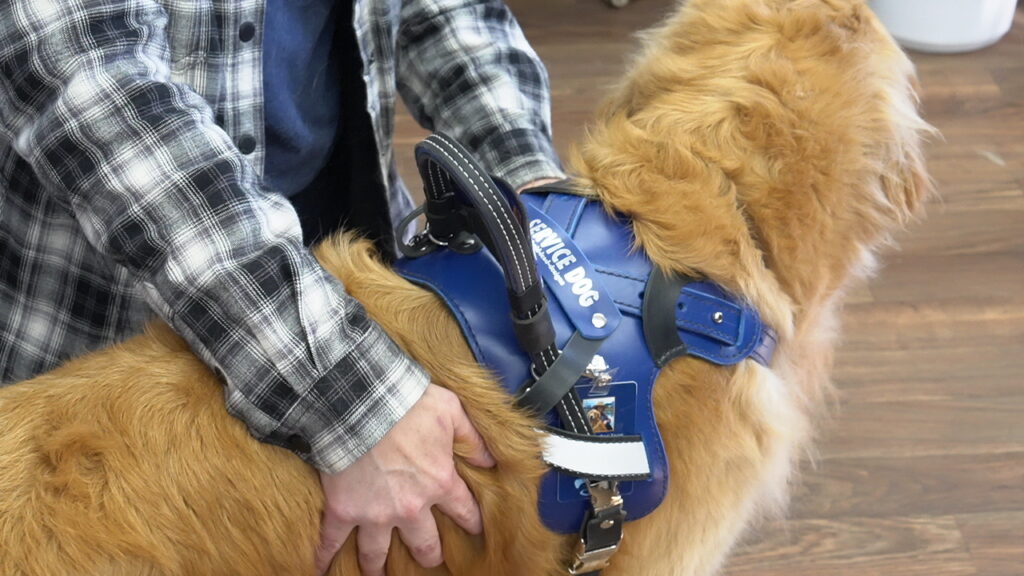
If you handle a service dog, you already know the question by heart. It’s not about paperwork or certifications. It’s a stranger in a store saying, “What does your dog do for you?”
And in that moment, you want a clean, confident answer ready — one that actually holds up under the law.
Here’s the thing most people don’t tell you: training behaviors that feel helpful but don’t legally count as tasks creates real problems. You can be denied access. You can spend months pouring your heart into training a dog who doesn’t have a single behavior that qualifies as work under federal law.
The ADA defines a service animal as a dog individually trained to perform work or tasks directly related to a person’s disability. Two non-negotiables live in that sentence: the behavior has to be trained — discrete, reliable, repeatable — and it has to be directly related to your disability. A dog who simply provides comfort doesn’t qualify, no matter how deeply helpful that dog feels to you. I know that can sting. But knowing the line is what protects your access.
So run every item below through this one filter before you train it:
Does this behavior address something my disability prevents me from doing safely or independently?
If yes, keep going. If no, it’s a trick, not a task.
One more thing before the list — and it’s the part almost nobody puts first. None of these tasks work if your dog isn’t on board with you. A dog can nail a task at home and lose it completely in the Target parking lot. That’s not a bad dog — that’s a missing foundation. It’s exactly why I built the 3C Method (Cortisol Reset, Clear Cues, Controlled Complexity), and it’s the real first step, long before you chain a single task.
Now — the list. Pick one or two that match your disability, define exactly what the trained behavior looks like, and start there.
Mobility assistance tasks
Keep in mind, while all service dogs should be medically cleared and healthy, with mobility dog tasks there are a lot more other considerations. You can review info on how to keep both you and your dog safe at Mobility Dog Resource Group.
- Forward momentum assist — gentle harness pull to help you walk or climb an incline
- Counterbalance support while walking
- Bracing on cue so you can stand up (with proper equipment and a dog built for it)
- Steadying you during transfers between surfaces
- Pulling a manual wheelchair short distances
- Retrieving dropped items — keys, phone, wallet
- Retrieving your cane, crutches, or walker
- Carrying items in a pack or delivering them to another person
- Opening doors with a tug strap
- Closing doors, cabinets, and drawers
- Pressing accessibility buttons for automatic doors
- Pressing elevator buttons
- Turning lights on and off
- Helping remove socks, sleeves, or a jacket
- Loading and unloading laundry
- Passing your wallet or card to a cashier
- Retrieving the phone in an emergency
- Standing as a stable block while you regain your balance
- Bracing to help you rise after a fall
- Alerting another person in the home when you need help
Guide tasks (blind and low-vision handlers)
- Obstacle avoidance along walking routes
- Overhead-hazard avoidance — low branches, signage
- Locating and stopping at curbs
- Locating and stopping at stairs
- Finding doors
- Finding an empty seat
- Finding a counter or register
- Following a designated person on cue
- Navigating around crowds and moving obstacles
- Intelligent disobedience — refusing a cue that would put you in danger, like stepping into traffic
Hearing dog tasks
- Alerting to a smoke or fire alarm, then leading you to the exit
- Alerting to the doorbell
- Alerting to knocking
- Alerting to your name being called
- Alerting to a ringing phone or text notification
- Alerting to your alarm clock
- Alerting to a baby crying
- Alerting to oven and appliance timers
- Alerting to approaching vehicles or sirens outdoors
- Alerting to someone approaching from behind
Psychiatric service dog tasks
- Deep Pressure Therapy (DPT) across your lap on cue
- DPT on your chest while lying down
- Paws-on-lap grounding contact
- Leaning body weight into your legs to ground you
- Repeated nose nudges to interrupt dissociation
- Panic interruption — pawing or nudging at your early distress signals
- Licking your hands to break an escalating anxiety loop
- Interrupting skin picking by redirecting your hands
- Interrupting hair pulling or scratching
- Nightmare interruption — waking you from night terrors with trained contact
- Turning on lights before you enter a dark room
- Room search on cue
- Crowd blocking in front of you to create space
- Blocking behind you
- Circling you to create a buffer in tight spaces
- Leading you to an exit on cue
- Leading you to a quiet, safe spot during sensory or emotional overload
- Guiding you back to your car or home when you’re disoriented
- Alerting to rising heart rate or hyperventilation
- Interrupting flashbacks with trained physical contact
- Retrieving medication on cue
- Trained medication reminders at a set time cue
- Waking you when medication makes sleep run deep
- Reality-check assist — a trained alert that helps you confirm whether a sound or person is real
- Positioning between you and a known trigger
- Retrieving a grounding object on cue
- Alerting a family member when you’re in crisis
- Activating a medical or crisis alert button
- Holding a settled anchor position to keep you oriented during a dissociative freeze
- Tactile stimulation on cue to bring you back to the present
Medical alert and response tasks
- Diabetic alert — detecting low blood sugar by scent
- Diabetic alert — detecting high blood sugar
- Prompting you to test your glucose after an alert
- Retrieving juice or glucose tabs
- Retrieving your glucometer kit
- Seizure response — staying with you through the episode
- Activating an alert button when a seizure begins
- Finding and bringing another person during a medical event
- Bringing medication during seizure recovery
- Applying DPT after a seizure
- Cardiac alert to changes that precede fainting (in dogs that show the aptitude)
- Bracing you to sit or lie down before syncope
- Prompting you to sit during a POTS episode
- Retrieving water so you can take medication
- Migraine alert by scent
- Allergen detection — peanut
- Allergen detection — gluten or other trained target allergens
- Waking you if you sleep through a medical alarm
- Fetching your emergency bag
- Barking on cue to summon help
Autism support tasks
- Interrupting self-injurious stimming
- DPT during a meltdown
- Guiding the handler out of an overstimulating environment
- Tethered walking support for elopement safety (child teams, with an adult handling)
- Alerting a parent when a child leaves a designated safe area
- Tracking and locating a child who has bolted
- Providing a trained touch anchor during difficult transitions
- Retrieving an AAC device or communication cards
- Blocking to prevent a child from running into a street
- Alerting to a designated sound the handler filters out, like their name or a timer
Quick reminders before you train
A quick word on the psychiatric and medical categories, because that’s where I see tasks quietly fall apart: the dog can’t just be present. Every task above has to be a discrete, trained behavior triggered by a cue you give or an observable signal your body sends. Seizure alert (detecting one before it starts) mostly can’t be deliberately trained — seizure response can. And scent work like diabetic alerting takes formal protocols, not casual exposure.
When someone asks what your dog does, name an observable action.
Strong: “She alerts to my medical episodes by nudging me, then guides me to a safe exit.”
Weak: “She calms me down.”
Per ADA guidance on the two permissible questions, the first answer holds up. The second doesn’t. Staff can’t require documentation, a demonstration, or details about your disability.
Start here
Use this list as a starting point, not a checklist. But before you pick a single task to train — make sure your dog is genuinely on board with you first.
▶️ Watch the free SmartCast — I’ll show you the very first move in service dog training: how to get your dog to want to listen to you and work with you out in public, instead of checking out the second things get distracting. It’s the foundation every task on this list is built on.