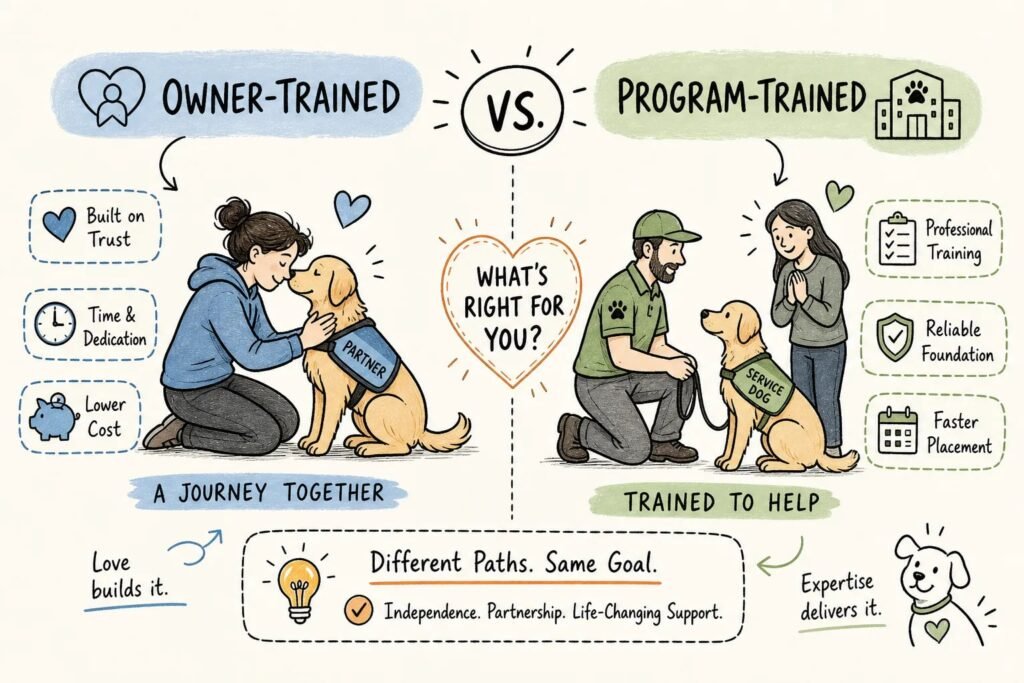
Program-trained service dogs cost anywhere from nothing (with a nonprofit, if you can wait) to $50,000 or more through a private placement organization, and the waitlists at major nonprofits regularly stretch two to three years. Choosing between an owner-trained vs. program-trained service dog affects far more than cost, it shapes your timeline, your legal standing, and how much daily labor lands on your shoulders. Then the questions start piling up: Is owner-training actually legal? Will your dog hold up? Can you do this while managing a disability at the same time?
At Collab Dog Training, we work with service dog handlers across both paths, and the questions we hear most often aren’t about training techniques. They’re about risk, cost, and whether owner-training is worth the effort. Both are legitimate questions, and both deserve straight answers rather than cheerleading for one option over the other.
What follows is a no-fluff breakdown of real numbers, legal standing, success rates, and the specific factors that determine whether a handler-trained team makes it. By the end, you’ll have a clear-eyed picture of each path and the tools to make a confident decision for your situation.
The real cost difference between the two paths
What a program-trained service dog actually costs
The full market for program-trained dogs spans a wide range. Large nonprofits like Canine Companions provide dogs at no charge to recipients, while Freedom Service Dogs of America similarly charges no fee but publishes a wait of at least three years after application acceptance. Private placement organizations sit at the other end of the spectrum, with costs commonly running $15,000 to $50,000 or more for a fully trained, placed dog.
That program price, whether paid by a recipient or covered by donor funding, bundles a lot: selective breeding, temperament testing, months of early socialization, task training, public access proofing, handler training, veterinary care during training, and follow-up support after placement. Programs also absorb the cost of every dog that washes out, which explains why the numbers look so high. When a “free” nonprofit dog takes three years to arrive, the waitlist is the real cost, even if no invoice changes hands.
Owner-trained vs. program-trained service dog: what each path costs in real dollars
A reasonable out-of-pocket estimate for owner-training with some professional guidance falls between $3,000 and $8,000 total. That breaks down into three main categories. Gear, vest, patches, quality leash, and training tools, runs roughly $50 to $500. Veterinary screenings, including OFA or PennHIP orthopedic clearances, cardiac and eye certifications, and breed-specific genetic testing, typically add $500 to $1,500. Professional course or coaching fees make up the largest variable: private service-dog coaching typically runs $150 to $250 per hour, and a year of weekly sessions can push toward $5,000 to $15,000 on its own. A structured online course with optional coaching support brings that cost down significantly.
The financial savings over program placement are substantial, but those savings don’t eliminate the time and labor investment. A realistic week might involve four to six short training sessions, public exposure outings, record-keeping, and troubleshooting setbacks. That trade-off needs to be on the table before anyone commits to self-training.
Owner-trained vs. program-trained service dog: timeline and what stretches it
The program timeline: waiting vs. training
Getting a program-trained dog involves two distinct phases, and people often underestimate both. The application and waitlist phase at major nonprofits commonly runs one to three years; Canine Companions publishes a wait of up to 20 months after acceptance, and some organizations run longer depending on the handler’s needs and available dog matches. Once matched, handlers still go through a handler training phase, sometimes called “team training”, before they leave with the dog. A program placement is not a ready-to-go dog with zero additional effort required from you.
The owner-training timeline
Most owner-trained teams reach public access readiness in 18 to 24 months, training several hours per week across short daily sessions rather than one long block. Task complexity is the biggest variable in that timeline. Psychiatric service dog tasks can come together in 12 to 18 months for many teams. Medical alert tasks, particularly scent-based alerts for cortisol or blood sugar, reliably push toward 24 months or longer because behavioral reliability on an odor is harder to build and proof than a physical task like deep pressure therapy or bracing.
The owner-training timeline is active work, not passive waiting. That distinction matters especially for handlers managing a disability simultaneously, because training demands don’t ease up during symptom flares or high-stress periods. Individual capacity will vary, and building honest expectations into your planning is not pessimism, it’s how successful teams actually prepare.
What the ADA actually says about owner-trained service dogs
Your legal right to owner-train
The Americans with Disabilities Act does not require professional training, program involvement, or any form of certification for a service dog. A handler may train their own dog. There is no federal registry, no mandatory ID card, and no standardized test a dog must pass to qualify under federal law. Businesses covered under Title II and Title III are generally limited to asking only two questions: whether the dog is required because of a disability, and what work or task the dog has been trained to perform. Documentation cannot be demanded as a condition of entry.
Where the legal picture gets more complicated
The ADA’s public access protections cover trained service animals, not dogs actively in training. That’s a meaningful distinction for owner-trainers. State law varies considerably: some states extend public access rights to service animals in training, while others do not, and the statutes shift frequently. A handful of states, including Colorado, Florida, Texas, and Virginia, have historically extended some in-training protections, but you should verify your state’s current statute before relying on that access. If your dog is still in the training process, check your state’s specific laws before taking them into public spaces. The federal standard requires that a dog be “individually trained to perform work or tasks” related to the handler’s disability, which means the burden of training quality falls entirely on the owner-trainer without external validation.
Success rates and what actually causes dogs to wash out
What the research shows about each path
Program-trained dogs show graduation rates that often cluster around 50 to 80 percent depending on the organization and how “success” is measured. Owner-trained teams in formally evaluated settings show success rates around 20 to 30 percent based on published assessments such as Assistance Dogs International’s public access test data, though outcomes reported informally across the internet range from much lower to much higher. Reading those numbers in isolation is misleading without understanding why programs and owner-trainers wash dogs for different reasons.
Programs may release dogs for reasons an owner-trainer would work around: a dog with manageable reactivity that a program won’t invest more time in, for example, might become a solid working dog in the hands of a patient, informed handler with a good training plan. That can make program “failure” rates look artificially high on paper while actually reflecting higher standards, not worse dogs.
The most common reasons dogs don’t make it
Behavioral failures top the washout list on both paths: fear, reactivity to strangers or other dogs, inability to settle in public environments, poor leash behavior, and hyperexcitability. Health and hereditary problems are a close second, and they’re an underestimated risk for owner-trainers who skip proper health screening before investing months of training. A dog that develops hip dysplasia at 18 months can’t do the work regardless of how well training has gone.
For handler-trained teams specifically, additional failure causes emerge that programs rarely face: insufficient training structure, lack of consistent mentorship, and the emotional difficulty of deciding to wash a dog you’ve lived with and loved for two years. That emotional variable is real and deserves honesty, not judgment.
What structured support looks like for owner-trainers
The gap between going it alone and paying program prices
The most common pattern for struggling owner-trainers isn’t a bad dog or low effort. It’s the absence of a real roadmap. YouTube videos and online forums offer a collection of unconnected pieces, no clear progression, no accountability, and no way to know what foundational skills you’ve skipped. The result is inconsistency and dogs that perform well at home but fall apart in actual public environments.
What structured professional guidance actually provides is a curriculum with a logical sequence, technique feedback before bad habits become ingrained, and a progression that mirrors what programs use, without the program price tag or multi-year wait. That structure isn’t a luxury; it’s one of the strongest predictors of whether an owner-trained team succeeds or washes out.
How the Public Access Prep course bridges that gap
Collab Dog Training’s Public Access Prep course was built specifically for this situation. It covers public access behavior standards, task training protocols, handler mechanics, and how to work through real-world environments reliably. The curriculum was developed by Lisa Gallegos, CPDT-KA, who specializes in service dog self-training and has worked with handler-trained teams across every major task category. The course is available as a self-paced online program with optional coaching support, which makes it accessible regardless of where you live or what your schedule looks like.
Having a curriculum rather than cobbling together free content is one of the clearest differentiators between owner-trained teams that finish and those that don’t. A course built around service dog standards gives you the same foundational structure programs use, scaled to a single team at a fraction of the cost.
How to decide which path fits your life
Signs a program might be the better fit
A program placement makes the most sense when the handler needs a dog quickly for immediate safety reasons and can’t wait 18 to 24 months for training to mature, when no suitable candidate dog is available, or when the handler’s disability significantly limits their capacity to run structured daily training sessions. If you have a condition that makes high-frequency, consistent training genuinely unmanageable, a program dog with professional support behind it is the more reliable path. “Free” nonprofit programs with long waits are still worth pursuing if your situation allows it: a three-year waitlist is painful, but it results in a dog with professional backing and follow-up support unavailable to most owner-trainers.
Signs owner-training could work for you
The honest criteria for a good owner-training candidate look like this: you have a dog under approximately three years of age with a calm, biddable, socially stable temperament; you’ve completed or are willing to complete appropriate health screenings; you have enough time in your week to train consistently across multiple short sessions; and you have access to structured support or professional guidance rather than trying to piece it together from scattered free content.
Owner-training is not the easier path. It requires time, consistency, and honest self-assessment about your dog’s temperament. Most of all, it requires someone who can tell you when you’re on track and when you’re not. But it is a legitimate path. Many handler-trained teams work reliably in public every day. The difference between the ones who succeed and the ones who don’t is almost always structure and support, not effort.
The bottom line on choosing your path
Program-trained dogs come with professional backing, higher average success rates, and ongoing support after placement. The barriers are real: cost, waitlists, and eligibility requirements that not everyone meets. Owner-training is legal under the ADA, achievable with the right dog and consistent effort, and significantly more affordable, but the data is clear that teams without structure and mentorship wash out at much higher rates.
Neither path is universally superior. The right choice depends on your timeline, your dog, your physical and cognitive capacity to train consistently, and the quality of support you can access. Those are individual variables, and they deserve individual answers.
When weighing owner-trained vs. program-trained service dog options, the most important question isn’t which path sounds better, it’s which path you can actually execute well. If owner-training fits your life, the next practical step is building on a real foundation. A structured, professionally developed curriculum gives handler-trained teams the same progression programs use, with the flexibility of self-paced learning and the option for direct coaching support. That’s exactly what you’ll find in the Public Access Prep course at Collab Dog Training, and it’s where many successful handler-trained teams start.