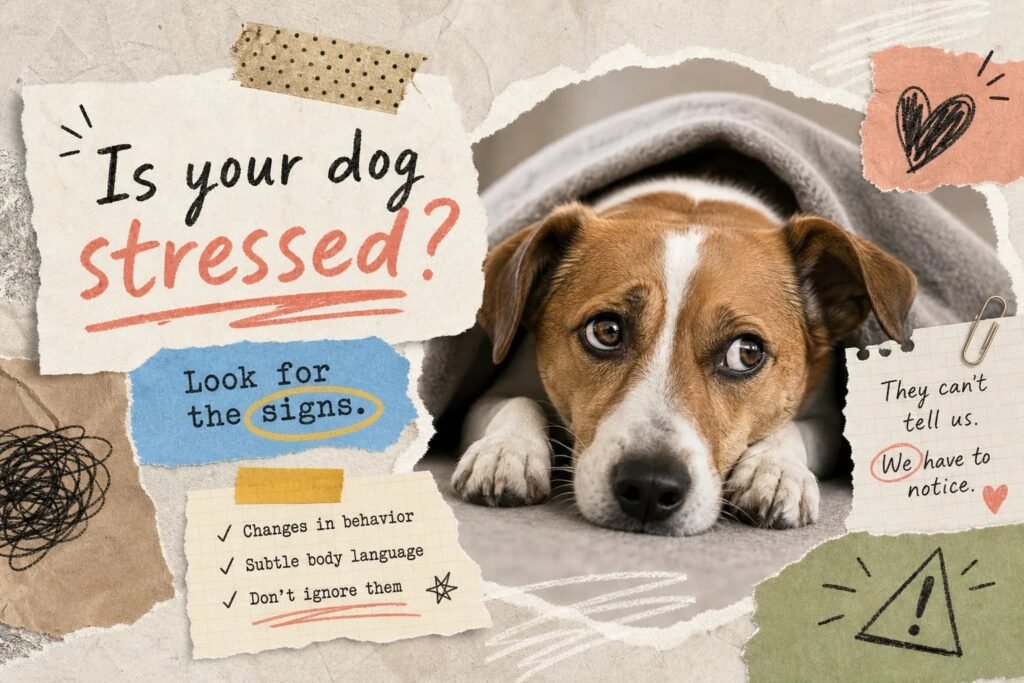
Picture this: you’re in the middle of a training session with your dog. You’ve been working on sit-stays for about ten minutes, everything seems fine, and then your dog starts yawning, an early dog stress signal you might miss entirely. Then they sniff the ground. Then they turn their head away and completely stop taking treats. You try again. Nothing. You chalk it up to stubbornness, maybe a bad day, and call it quits feeling frustrated.
What actually happened is that your dog told you, in a clear and consistent sequence of body language, that they were stressed and needed a break. You just didn’t have the vocabulary to hear it yet. That’s not a character flaw. It’s a gap in information, and it’s one of the most common things we see owners working through at Collab Dog Training. Understanding how dogs communicate discomfort is the foundation of real partnership. Without it, even the most well-intentioned training sessions can quietly chip away at a dog’s confidence and willingness.
This article walks through 12 dog stress signals, from the subtle ones that appear early to the more visible ones that show up as things escalate. You’ll also learn how to respond in the moment and how to recognize when it’s time to bring in professional support.
How to tell the difference between a tired dog and a stressed one
Before diving into individual signals, it helps to understand the broader distinction that makes all of them easier to read. The simplest framework: tired dogs look loose and soft; stressed dogs look tight and conflicted. That contrast will serve you well across everything that follows. Knowing it also helps you avoid the most common misread, mistaking shutdown for calm.
What “soft” vs. “tight” body language actually means
A relaxed dog has loose muscle tone throughout their body. Their face is calm, their eyes are soft, their tail hangs in a neutral position, and their movement is easy and flowing. A stressed dog, by contrast, carries visible tension. You might notice a tight brow, a stiff jaw, rigidity through the shoulders and back, or a stillness that feels locked rather than restful. Sometimes stress shows as agitated, repetitive movement instead. The key is that something about the body reads as “held” rather than free.
Why context is everything when reading dog stress signals
The same behavior can mean entirely different things depending on when and where it happens. A yawn when your dog is waking up from a nap is just a yawn. That same yawn during leash handling with a stranger approaching is a calming signal, your dog’s attempt to say “I’m a little uncertain here.” Context, timing, and pattern all matter. When you see multiple signals stacking on top of each other in a situation your dog finds challenging, that combination carries more weight than any single behavior on its own.
Subtle dog stress signals most owners miss
These are the early-warning signals that appear before stress becomes obvious. Dogs lead with these first. When owners miss them, dogs have no choice but to turn the volume up.
Yawning, lip licking, and other displacement behaviors
Displacement behaviors are actions that seem out of place because they’re being used as a release valve for inner conflict. A yawn when the dog isn’t tired, lip licking when no food is present, or sudden intense sniffing of the ground mid-greeting are all examples. These aren’t random, the dog is trying to self-regulate. In practice, lip licking looks like a quick flick of the tongue across the lips or nose, often repeated. Ground sniffing shows up as a sudden, urgent interest in the floor in the middle of an interaction. If you see these appearing in clusters or in tense situations, your dog is communicating discomfort before things get harder to manage.
Whale eye and averted gaze
Whale eye is when you can see the whites of your dog’s eyes, usually because their head is turned away but they’re still watching whatever concerns them. It often appears alongside averted gaze and deliberate head turns, which are not your dog being rude or stubborn. These are appeasement signals: your dog is actively trying to communicate that they’re not a threat and that they’d prefer the tension to decrease. When you see whale eye paired with a head turn, your dog is uncomfortable but still trying to manage the situation without conflict. That’s a signal worth responding to promptly.
Freezing and sudden “checking out”
Freezing is one of the most misread signals in dog behavior because it can look like calm compliance. There’s a real difference between relaxed stillness and tension-driven freezing. A frozen dog is rigid, not resting. Their breathing may be shallow, and the energy in their body reads as braced rather than settled. “Checking out” is a related phenomenon where a dog suddenly disengages, stares blankly, or stops responding to anything. This is not boredom. It’s cognitive overload, and it means the dog has mentally exited the situation because it became too much to process.
Clearer signs your dog is past their comfort zone
As stress escalates, it shows up more visibly in the body. These signs of anxiety in dogs are easier to spot, but owners still frequently misread them.
Physical signals that show up in the body
Panting when a dog is neither hot nor post-exercise is one of the clearest physical stress indicators. Shaking or trembling, dilated pupils, drooling without food present, and excessive shedding can all fall into this category, though stress-related shedding tends to be associated with prolonged or repeated stress rather than a single moment. Any one of these alone might have another explanation. When two or three appear together in a stressful context, the pattern becomes meaningful. Multiple signals together carry more diagnostic weight than any single sign.
What a tucked tail and pinned ears are actually telling you
A tucked tail, ears pinned flat against the head, a crouched or lowered overall body posture, and raised hackles along the spine are not just the “scared dog” image from cartoons. Each of these tells you something specific about a dog’s internal state. A low or tucked tail signals social submission and discomfort. Pinned ears are a protective response. A generally lowered body is an attempt to appear smaller and less threatening. Raised hackles don’t always mean aggression; they can also signal high arousal or uncertainty. Together, these posture signals tell you that stress is escalating and the dog is looking for a way out of whatever situation they’re in.
How dog stress signals show up during training sessions
Training is where dog anxiety symptoms matter most practically, because this is where owners have the most direct ability to respond and adjust.
Refusing treats and losing engagement
When a dog who normally loves treats suddenly stops taking them mid-session, the most common interpretation is that they’re “distracted” or “not motivated.” The more likely explanation is stress. Stress suppresses appetite, including for food rewards. A dog who won’t take high-value treats in a training context, especially one they readily accepted ten minutes ago, has likely hit or crossed their stress threshold. The same is true of a dog who stops offering behaviors, starts offering random ones unprompted, or simply walks away. These are not defiance. They’re communication.
Displacement behaviors mid-session and what they’re asking for
When a dog yawns between repetitions, sniffs the ground after a challenging exercise, or does a full body shake-off after something difficult, they’re asking for a change. At Collab Dog Training, reading these in-session dog stress signals is treated as a core training skill, not an afterthought, because genuine progress only happens when both ends of the leash are comfortable enough to engage. The difference between drilling for compliance and building a real partnership is whether the handler notices and responds to these moments. A dog who learns that their stress signals get heard becomes a more confident, more willing training partner over time.
Immediate steps to help your stressed dog in the moment
Here are practical, well-supported responses you can use as soon as you recognize that your dog is showing signs of stress. The tactics with the strongest evidence behind them, trigger removal, giving your dog space, and food-based counterconditioning, all share one thing in common: they work by reducing pressure rather than adding more.
Remove the pressure first
The most effective immediate step is to stop whatever is triggering the stress and create distance from it. Lower your criteria, shorten the exercise, or end the session on a simple, easy success your dog can feel good about. Ending a session early when your dog is stressed is not failure, it’s accurate reading. Staying below your dog’s stress threshold during training sessions helps prevent the negative learning effects that come from repeated overwhelm. A dog who gets to walk away before hitting their limit is far more likely to come back willing to engage next time.
Use food and a sensory reset to help your dog decompress
Scatter feeding on the ground, a lick mat, or a long-lasting chew can support calming after a stressful moment. Foraging and licking behaviors are associated with reduced arousal, and clinicians commonly use high-value food, lick mats, and long-lasting chews as a short-term aid during decompression. A quiet space, gentle and predictable handling, and the absence of further demands all help your dog settle. Give them real time to come down before resuming any training.
Rebuild engagement with smaller, lower-stakes steps
Once your dog has had a genuine break, reenter training at a lower difficulty level. Shorter sessions, familiar and well-practiced behaviors, and a higher rate of reinforcement all signal to the dog that the environment is safe again. This is how you prevent a pattern of repeated stress without resolution, which is the path toward stress becoming a learned behavioral response rather than an occasional reaction.
When stress signals mean it’s time to call a professional
Some situations move beyond what at-home management can address, and knowing the difference is important for your dog’s welfare.
Stress signs that point to pain or illness
Sudden behavioral changes, new or worsening anxiety that has no clear environmental cause, reactivity to touch that wasn’t present before, and physical symptoms appearing alongside behavioral stress are all reasons to see a vet before doing anything else. Conditions including pain from arthritis or dental disease, hypothyroidism, Cushing’s syndrome, gastrointestinal disease, and cognitive dysfunction can all produce behavior that looks like anxiety or fear. The practical rule is direct: if the behavior is new, escalating, or paired with any physical change, rule out a medical cause first.
Red-flag behaviors that need urgent professional attention
Some signals require prompt action rather than a wait-and-see approach. These include any aggression toward people or other animals, especially if it involves biting or escalating snapping with little warning; severe self-harm like chewing paws or attacking a limb; extreme phobia responses that prevent your dog from functioning normally; and panic-level distress around separation that involves sustained vocalization, destructive behavior, or elimination. A qualified trainer or behavior consultant is a sound starting point for many of these situations, but if there is any safety concern or if the problem is severe and not improving, a veterinary behaviorist is the appropriate level of care. Getting that help is not giving up on your dog, it is exactly what responsible partnership looks like.
Your dog is always talking: learning to listen changes everything
Recognizing dog stress signals is not about becoming a perfect trainer. It’s about becoming a good listener. Dogs communicate constantly through their bodies, and when owners learn to read those signals, training sessions become more effective, the relationship deepens, and problems get caught before they grow into something harder to address.
Start small. Pick two or three signals from this article and watch for them in your next session. Notice when your dog yawns, when they look away, when they stop taking treats. Let that information guide your response. You may be surprised by how much your dog has been trying to tell you all along.
If you want to go deeper on reading dog body language and building a force-free training partnership, Collab Dog Training’s free blog and YouTube resources are a practical next step. The best training relationship is one where both the dog and the owner feel safe enough to communicate honestly, and that starts with learning their language.